
Black Women Artists I Love: Janea Keith Is Creating Her Own Rules in Full Color
The Savannah-based abstract artist behind @artistrebel__ is building a practice rooted in color, individuality, faith, and the freedom to become.
By Bri Salley
Photography by Antwain Ross
There is something radical about refusing to become smaller.
For Janea Keith, the Savannah-based abstract artist known as @artistrebel__, that refusal is both philosophy and practice. Her work arrives in full color; bold, expressive, playful, and unconcerned with fitting neatly inside anyone else's expectations of what art, professionalism, Black womanhood, or even success should look like.
“I introduce myself as a free-hand, full-color abstract artist,” Keith says, describing a practice that has increasingly expanded into large-scale projects and murals. But the more revealing introduction might be found in her Instagram handle: @artistrebel__
“To rebel is to be me,” she says. “To go against the norm—especially with who I am, how I express myself, and how I create.” For Keith, rebellion is not simply about resistance. It is about permission. Permission to create boldly. Permission to change. Permission to take up space. Permission to be playful, sensual, spiritual, childlike, ambitious, and soft—all at once.
More Than Strength
The complexity of Black womanhood sits at the center of Keith's artistic perspective. Black women, she says, are frequently represented through familiar narratives of “strength, struggle, and resilience,” while the fullness of their inner lives can be overlooked.
Her work pushes against that flattening.
“My art highlights my softness, creativity, spirituality,” Keith says. “It’s sexy, childlike, and individuality—allowing Black women to simply exist, dream, and take up space in our fullness.”
That insistence feels particularly important in a cultural landscape that often celebrates Black women for what they can endure before acknowledging what they desire.
Keith wants her work to make Black women feel something beyond resilience.
“Boldness. Unapologetic. Playful. Confident. Sexy,” she says. “Not just strength. We’re more than our strength.”
The distinction is significant. Strength can be a source of power, but it can also become an expectation—a role Black women are repeatedly asked to perform. Keith's paintings offer another possibility: the freedom to be expansive without explanation.
Creating Through The Fire
Keith says she has always been an artist, though her practice came into fuller focus during one of the most difficult transitions of her life. Following her divorce, she began to understand creativity differently. “I’ve always been creating,” she says. “God put it in me, but it didn’t come to its fullness until last year coming out of my divorce.” One of the most personally significant works in her career was also one of her earliest paid murals. It was her second commissioned mural project, painted at an apartment complex while she was navigating the end of what she describes as an abusive marriage. “I remember crying while painting—good and bad tears,” she says. The act of creating became inseparable from the process of rebuilding. “When you’ve been mentally, emotionally, physically, financially, creatively abused, it was hard,” Keith says. “Creating it was a new beginning for me that opened up doors that I couldn’t even imagine.” There is a temptation to romanticize the artist's suffering—to suggest that pain naturally produces beauty. Keith's story is more complicated than that. The work did not erase what she had survived. But creating gave her somewhere to go. A new beginning. A different vision of herself.
Color, Movement and the Beat of Her Own Drum
Keith's studio process is intuitive and embodied. There is no rigid formula. She gathers her acrylic paints, puts on her headphones, queues up music, and lets herself move toward the work. “I’m very much a free spirit,” she says. Music is essential. Keith grew up surrounded by the sounds of her parents' record collection—the music of the 1960s and 1970s filling the atmosphere alongside gospel music. “I saw my parents always dancing to the groove of the music,” she says. That inheritance remains visible in her approach to art.

“My art is deeply inspired by the ’60s and ’70s,” Keith explains. “The color, the movement it creates.”
Her personal philosophy might be summed up by the lesson she draws from those worlds: love Jesus and move to the beat of your own drum.
It is a fitting framework for an artist whose work resists stillness.
Keith's paintings are built around color and movement rather than conventional representation. But she is quick to challenge the assumption that abstraction is somehow effortless.
“A lot of people think because it’s abstract it’s ‘easy,’” she says. “Abstract invokes thought and interpretation.”
The freedom of abstraction does not mean the absence of intention.
It requires practice.
It requires trust.
And perhaps most importantly, it requires the courage to allow viewers to bring their own experiences to the work.
An Artist Without Permission
Keith cites artists including Frankie Zombie, Keith Haring, and Romero Britto among the creative figures who have influenced her. What connects them, in her view, is not simply their use of bold color. It is their refusal to confine creativity to one surface. “[They] don’t just create on walls or a canvas,” Keith says. “It’s on shoes, clothes, etcetera. I relate because I do the same.” That multidisciplinary instinct is part of what makes Keith's work feel contemporary. She is not interested in building a practice around one narrow definition of what an artist should be And she is equally uninterested in reshaping her work to satisfy the market.
“I haven’t,” she says when asked how she balances meaningful work with commercial expectations. “I make art that I love, that is literally showing who I am as a person.” For Keith, making work solely to please an audience would contradict the very foundation of Artist Rebel. “If I make art pleasing to others or the art market, I wouldn’t create such bold, expressive artwork,” she says.
There is a lesson in that clarity. Emerging artists are often told to find their niche, study the market, anticipate trends, and make themselves legible to buyers. Keith is building from a different premise: begin with yourself. The market may follow. Or it may not. But the work has to remain honest.
Art in Service of the Community
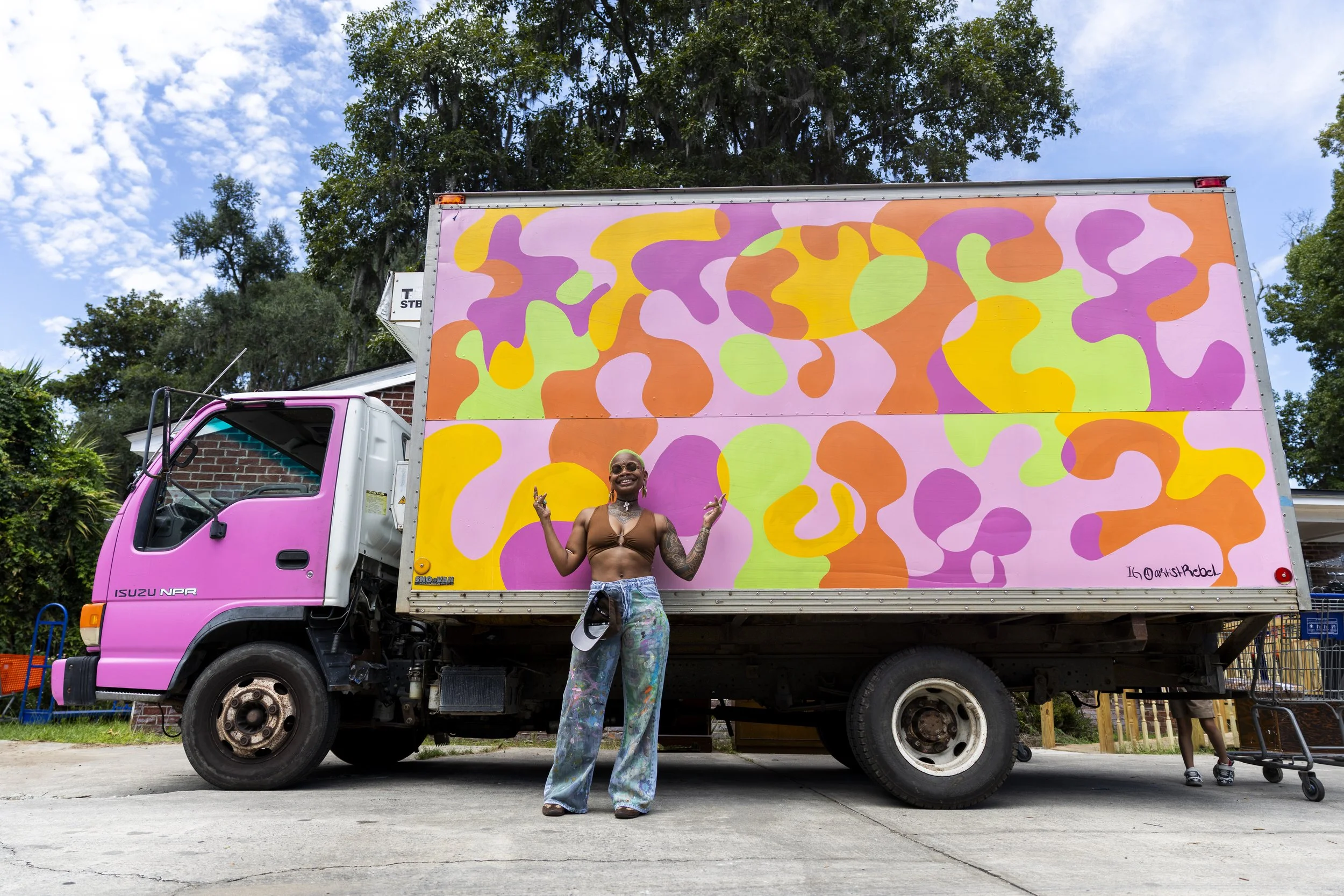
Janea Keith’s work is not confined to gallery walls, canvases, or private collections. In Savannah, her creative practice has also become part of the everyday machinery of community care. One of the delivery trucks serving WF Neighbors Feeding Neighbors Inc. was transformed by Keith into a moving work of art—her bold, full-color visual language traveling throughout the community alongside an organization dedicated to addressing food insecurity.
WF Neighbors Feeding Neighbors describes its work as “Love in Action,” providing nutritious food, essential resources, and community support to individuals and families facing food insecurity. The organization operates a food pantry, monthly food distribution initiatives, senior care programming, and a community garden, among other outreach efforts. The truck Keith painted is more than a vehicle. It is part of the infrastructure that allows care to move.
The painted delivery truck becomes a visible reminder that creativity can live beyond the traditional boundaries of the art world. It can exist on the road. It can become part of outreach. It can accompany groceries, resources, and acts of care as they make their way to neighbors across Savannah.
For Keith, who cites artists unafraid to take their work beyond the canvas as part of her creative lineage, the project represents another expansion of what an artistic practice can hold.
Sometimes, art hangs on a wall.
Sometimes, it helps carry hope.
Growing Into the Artist She Already Was
The biggest surprise of Keith's artistic journey has been the speed of her own transformation.
“What’s surprised me the most is how much my life has changed in a year,” she says. “How my art has grown, my confidence, the opportunities within the art world.”
That growth is already taking her beyond Savannah.
Her work is scheduled to be auctioned as part of an art exhibition in New York in the Fall.
For an artist who only recently stepped fully into the possibilities of her own practice, the expansion feels both significant and earned.
Still, Keith remains candid about the realities of building a creative career.
“Staying encouraged when sometimes the money looking funny,” she says, is among the biggest challenges.
It is an honest acknowledgment of the uncertainty that accompanies creative entrepreneurship. the quiet periods between commissions, the projects that do not materialize, the need to believe in yourself before there is consistent external evidence that others will.
Yet Keith continues.
And through the process, she has discovered something unexpected about herself.
“I’ve learned that I’m very patient,” she says. “That I have so much more in me creatively that I had no idea I could do.”
Her advice, born from experience, is simple:
“we’re way more capable than we think.”
The Legacy of Fullness
Keith is still emerging.
Still experimenting.
Still growing into the scale of what her practice might become.
She describes her work as evolving more than changing.
Her skills are expanding. Her opportunities are widening. Her creative confidence is becoming increasingly visible.
And when asked about legacy, she returns to a belief that has quietly guided the entire journey.
“I would hope my legacy is creating art that moves people to embrace their individuality, see beauty differently, and feel represented.”
It is a fitting ambition for an artist whose work is built around the refusal to flatten herself.
Janea Keith is not interested in being reduced to strength.
She is making room for softness.
For spirituality.
For sexuality.
For play.
For Black women who want to dream.
For artists still discovering what is possible after survival.
For anyone who has ever wondered whether becoming more fully themselves might, in fact, be the most rebellious thing they could do.
Keith's answer is already there—in the color, the movement, and the fearless permission embedded in the name Artist Rebel.
Be yourself.
Take up space.
And create something that looks like freedom.
Follow Janea Keith's work on Instagram: @artistrebel__
Black Women Artists I Love is a series celebrating the vision, practices, and creative worlds of Black women artists whose work deserves to be seen and supported.